Home
Our Process
Portfolio

FAQ
Where can I see your previous work?
Check out our portfolio at AppMakersLA.com/portfolio

What services do you offer?
We are a Los Angeles app and web development company. As such, we offer: 1) Design for Apps, Webapps and Websites 2) Mobile App Development for iPhone Apps, Android Apps and iPad Apps & Web Development for Webapps. Each project includes full QA Services as well as a product manager.
Where are your app developers located?

Our app developers are mainly located at 1250 S Los Angeles St, Los Angeles, CA 90015, though we have other offices around the world, and we hire the best developers wherever and whenever we find them. If having engineers & designers in Los Angeles is critical to the project, we have the resources to make that happen.

How much do you charge for your services?
Our cost varies depending on the project. Please contact us for a mobile app development consulting session and we will get you an estimate + analysis pronto.
Can you build software for startups?
Yes, we consider ourselves a startup app development company, as well as an agency that builds software for already established firms.

Discover 30+ more FAQs
View all FAQs
Blog
About
Contact ussms IconCall Icon
We answer our phones!
Popular Apps / How Waze Earns...

How Waze Earns Money, and Why the Model Just Changed

How Waze earns money used to be a story about one clever ad system. That story is over. In 2023 Google folded the Waze team into its Maps division. By late 2025 it started moving Waze's ads onto Google's own ad platform.

Waze is still free. It still shows ads only to drivers near a business. But the money now runs through Google's machine, not Waze's. If you build apps, that shift is the interesting part. It shows how location-based revenue actually works.

How Waze Earns Money in One Sentence

a phone mock up screens showing waze features

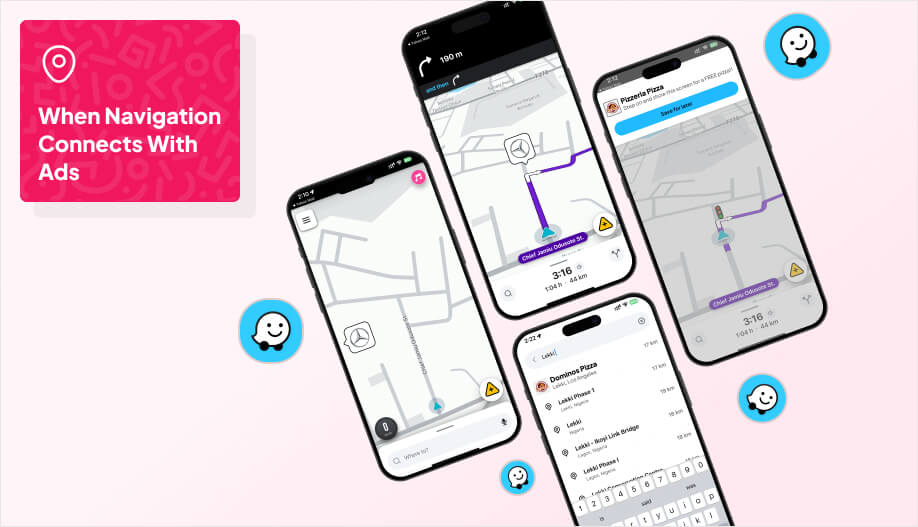
Waze earns money by selling location-based ads to businesses that want to reach drivers near them. A gas station, a fast-food chain, a car dealership pays to appear on the map at the moment a driver is close enough to pull in. The app stays free because businesses foot the bill, not you.

The twist, and the part most explainers still get wrong: since 2025 those ads increasingly run through Google Ads and Performance Max, not a separate Waze ad system. Waze is a surface now. Google is the store. That single change reshaped the whole business, and we'll walk through what it means below.

The Ad Formats That Do the Work

an aerial view of the cross-section lanes with visible traffic

Waze runs four core ad formats, and each one maps to a different moment in a drive. They still power the ads you see, even now that Google sells most of them.

FormatWhat it isWhen you see it
Branded PinA logo pin on the map, like a digital store signWhile driving past or near the business
Nearby ArrowA signpost with a logo that appears when the map opensAt the start of a session
Zero-Speed TakeoverA full-screen ad, like a digital billboardOnly when the car is fully stopped
Promoted SearchPriority placement at the top of search resultsWhen you actively search a category

The Zero-Speed Takeover is the clever one. It only fires when you are stopped at a light or in traffic, so it never competes with the road.

Waze says that format reaches drivers about 3.1 times farther from a business than a Branded Pin does, because a stopped driver will look at a screen a moving one won't.

Promoted Search comes free with a campaign.

And the whole thing starts cheap: the self-serve tier for small businesses still opens at a $2 daily budget, which is how a single pizza shop and a national chain end up on the same map.

That low floor matters for the model, and the data behind it is where Waze gets interesting.

What Changed: Waze Ads Moved Into Google Ads

The biggest change to how Waze earns money is that Waze stopped running its own ad business. Google merged the Waze team into its Maps and Geo organization starting in late 2022, cut jobs on the Waze Ads side in 2023, and handed monetization to the same Google sales org that runs Google Maps ads. Waze's longtime CEO left and wasn't replaced.

Then came the real integration. In November 2025 Google began placing Waze ad inventory inside Performance Max, the automated campaign type most of its advertisers already use.

Google's own Performance Max documentation now lists the placement as "Promoted Places in Navigation," an extension of its Local Ads. A business running a store-visits campaign can show up as a promoted place on the Waze map with no Waze-specific setup.

The U.S. rollout started that month. Google says the expansion to markets beyond the U.S. is coming in 2026.

Read that plainly. Waze's revenue is now a line item inside Google's ad engine. The upside is scale: every advertiser Google already has can reach Waze drivers with one checkbox.

The cost is independence. Waze no longer controls its own money. For a product Google bought for about $1.1 billion in 2013, that was probably always the endgame. Which raises the question every driver asks: what is Google getting from all your driving?

Does Waze Sell Your Location Data?

No. Waze does not sell your precise personal location to advertisers, and it never has. Ad targeting works on proximity in the moment, not on a profile of where you've been. An advertiser buys "drivers near this address," and Waze decides who's close. The advertiser never gets your identity or your history.

What Waze does with driving data is different. It aggregates and anonymizes movement into traffic patterns, then shares much of that back through its Waze for Cities program, a free two-way data exchange with governments and transport agencies. Cities send Waze road-closure and construction data.

Waze sends cities anonymized traffic flow. Neither side pays. It isn't a direct revenue line, but it keeps the map accurate, and an accurate map is the only reason the ads are worth anything. This is the honest version of "ethical data": not charity, but a model where good data and paid ads reinforce each other. The one revenue experiment Waze ran outside that loop is the one it killed.

The Waze Carpool Experiment, and Why It Ended

a carpool showing 5 passengers including the driver

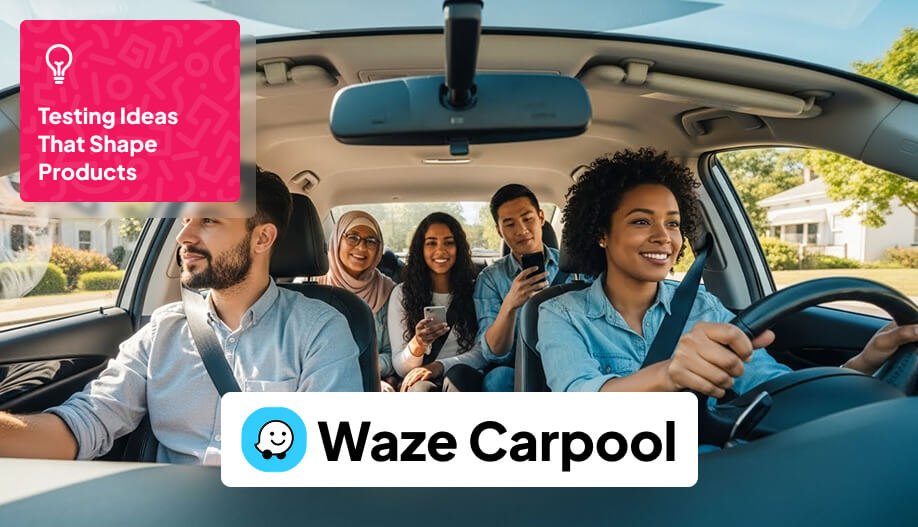
Waze Carpool was the company's one real attempt to earn money directly from users, and it shut down in 2022. The idea was matched commuting: a rider heading the same way as a driver split the trip, and Waze took a small per-match fee.

It was never meant to be a taxi service. Riders paid something close to gas money, not a fare, which was the whole point and also the problem.

The economics never worked at Waze's scale. A per-match fee on cheap commuter trips doesn't add up to a business when the rides are priced to barely cover fuel. Google pulled the plug and moved the people to Maps.

The service is gone, but it left behind years of commuting-pattern data that still helps the core navigation product route you around a jam. That is the pattern with Waze: even the failures feed the map. Now look at what actually drives the numbers.

Waze by the Numbers

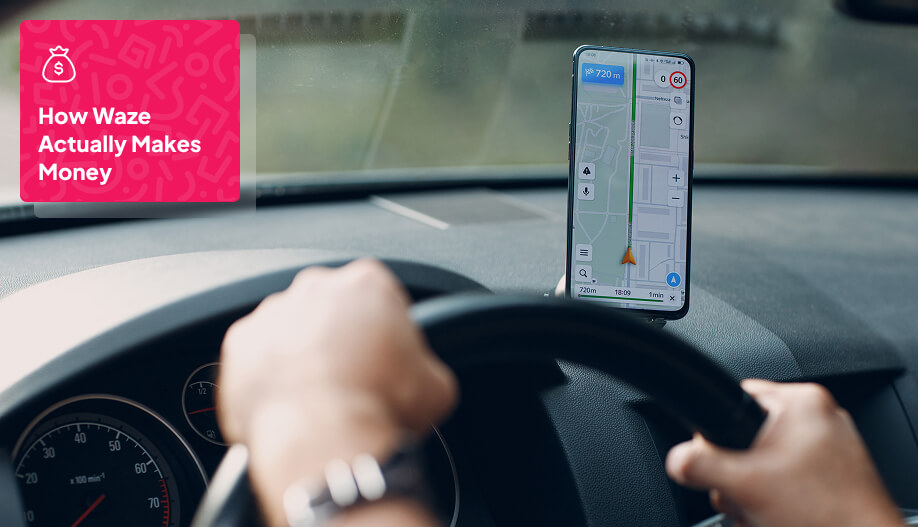
a driver navigating the map in waze

Here's the honest state of the numbers, because most articles on this topic quote figures Google never published. Google does not break out Waze's revenue. Alphabet reports it inside a much larger advertising line, so any specific "Waze made $X million" figure you see online is an estimate, not a reported number. Treat those with suspicion.

What can be stated with confidence:

  • Users: Waze doesn't publish a single global monthly-active-user count. Estimates put it around 150 million monthly users across roughly 185 countries. The hardest figure available is Europe, where Waze reported 50.5 million average monthly users in the EU for the second half of 2024, filed under the EU's Digital Services Act.
  • The acquisition: Google bought Waze in 2013 for about $1.1 billion.
  • Ad entry price: the self-serve small-business tier still starts at a $2 daily budget, with radius-based targeting around a location.
  • Beacons: Waze Beacons are small Bluetooth transmitters mounted in tunnels and underground stretches where GPS drops out. Road operators buy and install them so navigation keeps working underground. It's a minor hardware line, not a core revenue driver.

The pattern that matters isn't any single number. It's that Waze earns nothing from a huge, engaged user base except through ads shown at the right moment. That is a hard model to build, and it's the part worth studying if you're building anything of your own.

What Founders Can Learn From Waze's Money Model

The real lesson from Waze is that location-based revenue is an engineering problem before it's a business model. Waze can charge for "drivers near this store" only because it can answer, fast and constantly, the question of who is actually near it. That sounds simple. It is not.

We know this because we've built it. On ShiftPass, a two-sided jobs marketplace AppMakers USA engineered, every core screen runs the same kind of proximity query Waze's ad model depends on: a seeker finding jobs near them, a manager finding workers near a shift.

Our engineers built that on PostGIS geography columns in Postgres, using real Earth-distance math instead of flat latitude-longitude approximations, so one query handles both the "near me" list and the live map view at once.

We rejected the easy path (a bolt-on search service like Algolia) because the relational joins between job, business, address, and application status dominated the workload, and a search index would have split one question into two systems. The payoff is that proximity isn't a feature you add later. It's the foundation the money sits on.

That's the takeaway for anyone eyeing an ad-supported or marketplace app. A free app with a "we'll monetize with location ads later" plan is really a bet that you can build Waze-grade geo infrastructure on demand.

You usually can't retrofit it. AppMakers USA builds that foundation in from the first sprint, which is why our custom software development work on marketplace and geo products starts with the data model, not the UI.

Aaron Gordon

Aaron Gordon

Aaron Gordon is the Chief Operating Officer at AppMakers USA, where he leads product strategy and client development, taking apps from early concept to production-ready software with high impact.

Ready to Develop Your App?

Partner with App Makers LA and turn your vision into reality.
Contact us

Frequently Asked Questions (FAQ)

Yes, Waze is free with no subscription, and Google has kept it that way since 2013. The app is monetized entirely through ads, so there's no current signal that a paywall is coming.

No. Google Maps is far larger and Google does not report either product's revenue separately. Since 2023 both are monetized by the same Google ad organization, so they're now less like rivals and more like two surfaces selling the same kind of local ad.

The self-serve tier for small businesses starts at a $2 daily budget with targeting set by radius around a location. Larger, managed campaigns now run through Google Ads and Performance Max, where budgets scale to whatever the advertiser sets.

Google paid about $1.1 billion in 2013 mainly for Waze's community: millions of drivers reporting jams, police, and hazards in real time. That live human-reported data was faster to buy than to rebuild, and it still feeds routing today.

Not entirely. Waze limits ads to safe moments (only Branded Pins while moving, full-screen takeovers only when stopped), but there's no ad-free paid option. The trade for a free navigation app is the occasional promoted pin.

See more
Chevron-1

Where Waze's Model Could Go Next

The most likely change to how Waze earns money is simply more of Google's ad inventory flowing through it. Now that Waze sits inside Performance Max, the obvious move is to open more ad types and more countries, turning the map into another Google ad surface alongside Search, YouTube, and Maps. That expansion is already underway for 2026.

Beyond ads, the openings are the ones that fit driving. EV routing and charging-stop placement is a natural paid surface, since charging networks have a clear reason to pay for position. A light premium tier (custom voices, cleaner map, no takeovers) could work, though Google has never seemed eager to charge Waze users directly.

Fleet and logistics analytics, built on the same anonymized movement data, is the enterprise angle that doesn't touch consumer trust. None of these are guaranteed. But each one rides the same rule Waze has followed since 2013: monetize the drive people are already taking, and never make them fight the road to see an ad.

That discipline, more than any single feature, is why the model still holds. It's also the discipline most apps skip, which is exactly where the ones that copy Waze go wrong.


Exploring Our App Development Services?

Share Your Project Details!

Vector-60
We respond promptly, typically within 30 minutes!
Tick-4
  We’ll hop on a call and hear out your idea, protected by our NDA.
Tick-4
  We’ll provide a free quote + our thoughts on the best approach for you.
Tick-4
  Even if we don’t work together, feel free to consider us a free technical
  resource to bounce your thoughts/questions off of.
Alternatively, contact us via phone +1 310 388 6435 or email team@appmakersla.com.
    Copyright © 2026 AppMakers. All Rights Reserved
    Follow us on socials:
    linkedin facebook pinterest youtube rss twitter instagram facebook-blank rss-blank linkedin-blank pinterest youtube twitter instagram