Understanding how to build an AI agent should be a top priority for businesses aiming to scale with one. This could be a strategic move that can redefine how your business operates, scales, and interacts with users.
From automating workflows to powering intelligent decision-making, AI agents are becoming essential building blocks of modern digital systems. But turning that vision into a fully functioning agent isn’t about coding alone. It starts with clear goals, curated data, and the right frameworks, and all these unfolds through collaboration, iteration, and strategic deployment.
In this guide, we’ll break down what it really takes to build an AI agent that performs in the real world.
Founders, product leads, or developers will benefit from this article as we discover the key phases and pitfalls plus the tools that can help your agent scale with confidence.

Before you build an AI agent, one step matters more than any other: defining what success looks like. Without clear goals, even the best technology falls short. AI agents are autonomous systems designed to perform tasks on behalf of users or other systems—so purpose and scope must be aligned with business priorities from the start.
Begin by outlining specific tasks you want the agent to perform. Whether that’s resolving support tickets, automating IT operations, or analyzing user feedback. Define success metrics such as resolution time, output accuracy, or user satisfaction to ensure measurable outcomes. These benchmarks will guide your build and help you iterate meaningfully post-launch.
Next, map the agent’s environment: what data will it rely on? What external systems will it interact with? Environmental context—such as sensor inputs, APIs, or user-facing apps—shapes how the agent functions in real time. Identify real-time data streams like live chat logs or transaction histories to ensure adaptability to changing conditions.
This is also the stage to set limitations. Clearly defining what the agent should not do prevents feature creep and ensures that early-stage testing remains focused. Starting with narrow objectives allows for faster feedback and reliable iteration based on real usage data.
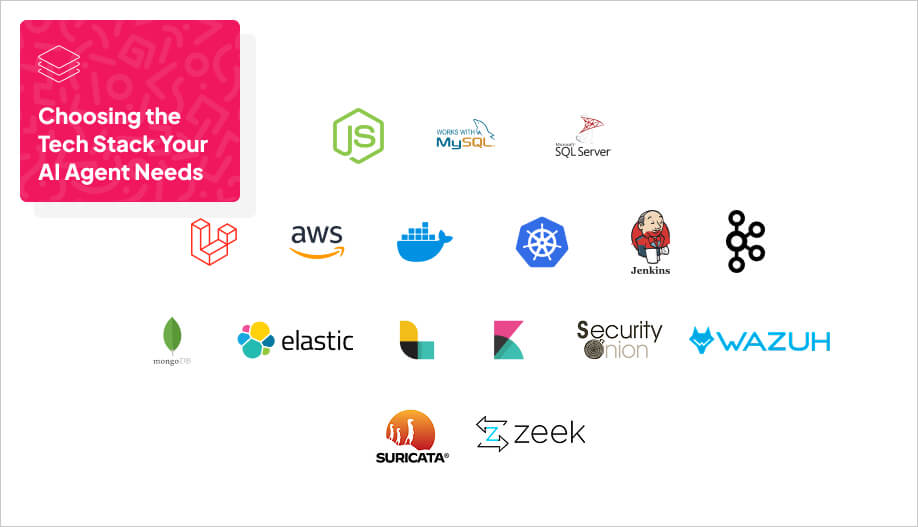
Once your goals are clear, it's time to choose the tech stack that will bring your AI agent to life. The right tools directly influence your agent’s scalability, maintainability, and performance.
Start by matching your needs to the strengths of available technologies. If you’re focused on rapid prototyping and NLP, Python is often the go-to, thanks to its simplicity and extensive library ecosystem. For high-performance enterprise environments, Java offers strong scalability and concurrency support.
When it comes to AI-specific frameworks, TensorFlow and PyTorch dominate for good reason. TensorFlow is favored for its versatility and production-grade deployment features, while PyTorch is ideal for dynamic development and experimentation. Your choice should reflect your team's familiarity and your application's complexity.
Here’s a quick breakdown to help guide your decision:
| Technology | Strengths | Considerations |
|---|---|---|
| Python | User-friendly, rich libraries | May need optimization for speed |
| Java | High performance, scalable | Longer dev cycles |
| TensorFlow | Mature ecosystem, scalable ML tools | Steeper learning curve |
| PyTorch | Flexible, great for experimentation | Less production-ready out of the box |
AppMakers USA can help you navigate this stage, where you match goals with the right stack and frameworks to ensure your AI agent is set up for long-term success.

If your AI agent is the engine, data is the fuel and not just any fuel, but high-octane, precisely refined input. Successful AI development hinges on clean, structured, and context-rich data.
That’s why investing in data preparation is foundational.
To start, focus on eliminating duplicates, standardizing formats, and resolving missing values. These steps build a trustworthy dataset that won’t introduce bias or confusion into your agent’s logic. But don’t stop at cleanup. Enrich your dataset through augmentation techniques that simulate real-world variability and improve the robustness of your model’s output.
In the sections that follow, we’ll expand the concept of data collection and augmentation in the context of data handling and preparation.
Before your AI agent can learn to act intelligently, it needs a solid education and that begins with the right training data. Collecting high-quality, relevant, and diverse data is the bedrock of successful model development.
Start by defining clear training objectives to ensure every dataset you collect serves a purpose aligned with your agent’s intended tasks. Internal sources such as CRM systems, transactional logs, or IoT device outputs often provide rich, domain-specific insights. When used correctly, these data streams become powerful fuel for training accurate, context-aware models.
For broader coverage, supplement your internal data with external sources. Public datasets like ImageNet offer foundational training material, while crowdsourcing platforms such as Amazon Mechanical Turk can generate labeled data tailored to your use case. Scrapy and other web scraping tools help automate data collection at scale, pulling in everything from news articles to product reviews. In high-regulation fields like healthcare or finance, synthetic data generation using GANs (Generative Adversarial Networks) provides a secure way to model rare or sensitive scenarios without compromising compliance.
Looking to keep your AI agent adaptable and real-time? Integrate API-based sources like Twitter or financial market feeds for dynamic data streams. And for projects requiring rapid expansion, generative AI can augment sparse datasets, offering simulated inputs that reflect real-world complexity.
When done right, training data will be the blueprint for your AI’s intelligence. AppMakers USA ensures that every data source is optimized for accuracy, diversity, and alignment with your business goals.
High-quality data collection is just the beginning, but what comes next determines whether your AI agent learns accurately or veers off course. Data preprocessing and augmentation are two critical steps that turn raw information into a strategic asset.
Start by cleaning and structuring your dataset. Identify and fill in missing values using methods like statistical imputation (mean, median) or more advanced algorithms such as K-Nearest Neighbors. Outlier detection using z-score analysis or clustering models helps ensure your training data doesn’t skew predictions. These steps are essential for GenAI projects, where small data inconsistencies can dramatically impact performance.
Once your data is clean, transformation techniques such as normalization and standardization prepare it for machine learning pipelines. Feature engineering plays a key role here—by creating new variables or combining existing ones, you can unlock patterns that would otherwise remain hidden. Encoding categorical variables and scaling numerical ones further ensures that your model processes the information efficiently and accurately.
But even the most polished machine dataset has limitations if it lacks diversity. That’s where data augmentation comes in.
In computer vision, image flipping, cropping, or adjusting brightness helps models recognize patterns under varied conditions. In audio processing, injecting noise or modifying speed simulates different environments, training the agent to be more resilient. For natural language processing, techniques like word substitution, sentence shuffling, or back translation create textual variations that make language models more robust.
Here’s a quick snapshot of augmentation in different domains:
| Domain | Augmentation Examples | Purpose |
|---|---|---|
| Computer Vision | Flipping, rotation, brightness adjustment | Boost generalization & spatial awareness |
| Audio Processing | Noise injection, speed shift, time stretch | Simulate diverse environments |
| NLP/Text | Word replacement, paraphrasing, back translation | Improve linguistic adaptability |
AppMakers USA leverages these preprocessing and augmentation strategies including cutting-edge methods like neural style transfer and GAN-generated data to help you scale more effectively, even when real-world data is limited.

Behind every successful AI agent is a strategically assembled team with the right mix of expertise and adaptability. While technology drives the capabilities of your agent, it’s the people behind it who shape its accuracy, ethics, and user experience.
AI agents are autonomous systems that perceive their environment, gather and process data, and execute complex tasks with minimal intervention. To bring this level of functionality to life, your team needs to cover a range of critical responsibilities, from data modeling and ML pipeline development to user experience and systems integration.
Thanks to the rise of no-code and low-code platforms like Relevance AI, building foundational agent capabilities is now more accessible than ever. However, whether you’re launching a proof of concept or scaling an enterprise-grade solution, having the right team in place remains a non-negotiable.
In the next two subsections, we’ll break down:
Building an AI agent is a coordinated effort that demands the right mix of skill sets, from leadership to data science. Assembling a focused, cross-functional team ensures your agent performs reliably, scales efficiently, and stays aligned with business goals.
At the center is your Team Manager & Software Developer, who handles resource allocation, sets priorities, and keeps the development roadmap on track. Supporting them is a Documentation Manager, responsible for maintaining clear, version-controlled records of system changes and decision logs—a key asset for compliance and iteration.
You’ll also need a Data Scientist to interpret user behavior, identify workflow patterns, and recommend optimizations that inform both the model and business logic. Since AI agents learn and adapt over time, their performance depends on how well your team translates real-world data into actionable insights.
Additional roles—like a Quality Assurance Manager to monitor outputs, or a Product/AI Liaison to bridge tech and business objectives—ensure your agent doesn’t just function, but thrives in real-world applications.
If you're using platforms like OpenAI’s Agent SDK, many foundational tasks such as routing and basic agent logic are abstracted, letting your team focus on strategy, UX, and innovation rather than low-level engineering.
Here’s a quick overview:
| Role | Key Responsibility |
|---|---|
| Team Manager & Software Developer | Oversees execution, manages tasks and resources |
| Documentation Manager | Maintains accurate, up-to-date project records |
| Data Scientist | Extracts insights and predicts optimization paths |
With the right people in place, you're not just building an agent, you're creating an intelligent system that evolves with your business.
When it comes to building your AI agent, deciding between in-house development and outsourcing is more than a budget conversation, it’s a strategic call that can shape your long-term velocity, quality, and control.
In-house development gives you full visibility and ownership of the project. You can tailor every component to your exact specs, align tightly with internal workflows, and retain complete control over your data and codebase. This approach is especially useful for projects requiring deep customization or tight integration with proprietary systems.
But that level of control comes at a cost. Recruiting experienced machine learning engineers, UX specialists, and data scientists can delay timelines and inflate overhead. Infrastructure costs—such as cloud usage, compute resources, and security—also scale quickly. And without clear direction, in-house teams can fall prey to technical drift.
Outsourcing, on the other hand, gives you access to specialized expertise and fast-tracked execution. You gain a plug-and-play development team that already knows how to ship—leveraging proven workflows, tools, and models. It’s particularly advantageous for startups and non-technical founders who need to move fast without sacrificing quality.
Still, outsourcing isn’t without risks. Without clear communication and strong alignment, quality assurance can falter. You may lose visibility into day-to-day progress unless the partner provides consistent checkpoints and collaborative transparency. That’s why selecting the right team matters just as much as choosing to outsource in the first place.
Here’s a quick comparison to help clarify your direction:
| Approach | Benefits | Considerations |
|---|---|---|
| In-House | Full control, deep customization, team proximity | High cost, longer timelines, recruiting challenges |
| Outsourced | Fast execution, access to top talent, lower overhead | Requires strong alignment and quality management practices |
It’s also worth noting: over 80% of AI models are never deployed—often due to performance issues or unclear scope. Avoiding that fate depends on choosing the right development approach and the right collaborators.
At AppMakers USA, we help companies evaluate both paths and offer hybrid solutions when needed. Whether you need full-service development or just expert augmentation, our agile workflows keep your project on track, delivering AI agents that actually launch, scale, and perform.

Designing and launching an AI agent that performs well in the real world starts with thoughtful planning and ends with rigorous testing. This phase is where ideas meet execution and where most AI initiatives either succeed or stall.

Your model’s architecture is the foundation of your agent’s intelligence. Begin by selecting a layered structure that aligns with your agent’s task—whether that’s classification, prediction, or generative behavior. Tune hyperparameters like depth and neuron width to balance complexity and efficiency. Overengineering can lead to slower models, while underengineering may miss important nuances.
Equally critical is feature engineering. Extracting relevant input variables and applying normalization techniques ensures your model doesn’t get skewed by dominant data points. Clean, consistent input = cleaner, more consistent output.
Transparency is no longer optional especially in high-stakes applications. Leverage explainability tools like LIME or SHAP to uncover how your model arrives at decisions. This builds user trust and helps identify hidden bias.
Here's a streamlined overview:
| Design Element | Why It Matters |
|---|---|
| Layer Architecture | Structures learning patterns and decision paths |
| Feature Engineering | Ensures only relevant data drives model outcomes |
| Input Normalization | Prevents dominant features from biasing results |
| Model Interpretability | Builds user trust and supports compliance |
Once designed, the model must be trained using well-prepared data. Begin by splitting your dataset into training, validation, and testing sets, ensuring each is representative of real-world conditions. Eliminate noise, address class imbalances, and document any augmentation techniques used to enhance robustness.
Now it’s time to evaluate whether your model can perform under pressure.
Establish performance benchmarks early on—accuracy, response time, memory use—and construct a test suite that includes both common use cases and edge-case scenarios. Think of it like preparing an athlete not just for game day, but for the unexpected curveball.
Key testing strategies include:
Once the model passes testing, roll it out in stages. A staged deployment (e.g., via canary or blue-green deployment methods) minimizes risk by isolating performance issues early. Load testing helps validate scalability, and real-time telemetry allows for performance tracking post-launch.
Maintenance shouldn’t be an afterthought. Incorporate feedback loops that continuously feed user data back into model refinement. Think of your agent not as “done,” but as “always improving.”
At AppMakers USA, we help businesses navigate every stage of AI agent development—from early design to real-world deployment—ensuring performance, reliability, and responsible implementation.
Let’s bring your AI vision to life intelligently, ethically, and at scale.

Building an AI agent is just the beginning. The real value lies in how well it performs over time and how quickly it can adapt. That’s where continuous monitoring and feedback loops come in.
To ensure your agent remains aligned with your goals and user expectations, embed observability into the system from day one. Tools like Langfuse allow you to track every execution step, trace anomalies, and monitor resource usage with precision. By enabling real-time alerts for spikes in latency or cost, you can proactively address issues before they escalate.
For full pipeline transparency, integrate your AI stack with CI/CD solutions like OpenLLMetry. These platforms enable seamless change tracking across your models, prompts, and workflows so your team always has a clear view of what’s deployed and why.
When refining performance, feedback is fuel. Regularly pull in real-world usage data to retrain models, tweak prompts, and update workflows. Use canary deployments to test new changes on a small percentage of users, reducing risk. If issues arise, automated rollbacks ensure stability. A/B testing different prompt strategies or interaction flows helps you identify what actually improves user experience.
This iterative approach keeps your AI agent flexible, reliable, and aligned with evolving user needs.
Timelines can vary widely depending on the agent’s complexity, the availability of clean training data, and whether you're building in-house or outsourcing. A basic prototype may take 2–4 weeks, while enterprise-level agents that require multi-layered integrations, rigorous testing, and real-time capabilities can take several months. Working with experienced teams like AppMakers USA can accelerate delivery through proven workflows and prebuilt components.
Yes, thanks to no-code and low-code platforms, non-technical founders and product leads can now develop foundational agents without deep ML knowledge. However, for production-grade deployment, especially in regulated industries, collaborating with AI engineers, data scientists, and QA professionals is essential to ensure performance, reliability, and compliance.
The quality of your training data matters more than the quantity. Internal sources like CRM logs, support transcripts, and sensor data provide rich, context-specific inputs. External datasets, synthetic data, and real-time APIs can supplement gaps. It’s essential to ensure this data is clean, labeled appropriately, and aligned with the agent’s core goals to avoid bias or irrelevant outputs.
This is why robust monitoring, feedback loops, and version control are critical. Tools like Langfuse and OpenLLMetry allow for real-time diagnostics and rollback capabilities. Automated alerts help identify and isolate issues before they impact users, and A/B testing lets you validate changes before rolling them out more broadly.
Retraining becomes necessary when user behavior shifts, new data patterns emerge, or model performance declines. Periodic updates such as refining prompts, refresh datasets, or enhance workflows, keeps your agent relevant and reliable. A continuous feedback loop ensures your AI agent evolves alongside your business needs and user expectations.
Building an AI agent is about transforming ideas into intelligent, adaptable systems that scale with your business. From strategic planning and data preparation to model training and post-deployment monitoring, every stage plays a vital role in ensuring your agent delivers real value. And while the process can seem daunting, the right frameworks, tools, and team make all the difference.
At AppMakers USA, we bring deep technical expertise and a founder-focused mindset to help you architect AI agents that aren’t just functional, they’re impactful. Whether you’re starting with a blank canvas or optimizing an existing build, our custom development approach ensures your AI agent aligns with your goals and evolves with your market.
Your roadmap to launching a reliable, scalable AI agent starts here.
Ready to take the next step? Let’s build it together.